
As we see the leaves change and temperatures cool, evidence abounds that autumn is upon us. For many places in the United States fall is a pleasant time of year that provides a respite from the searing temperatures of summer. In terms of markets however, fall can be one of the more volatile times of the year and this year has been no exception. For this month’s Insights, we’ll be exploring how markets perform during different times of the year and the themes that are currently driving markets.
Market Performance
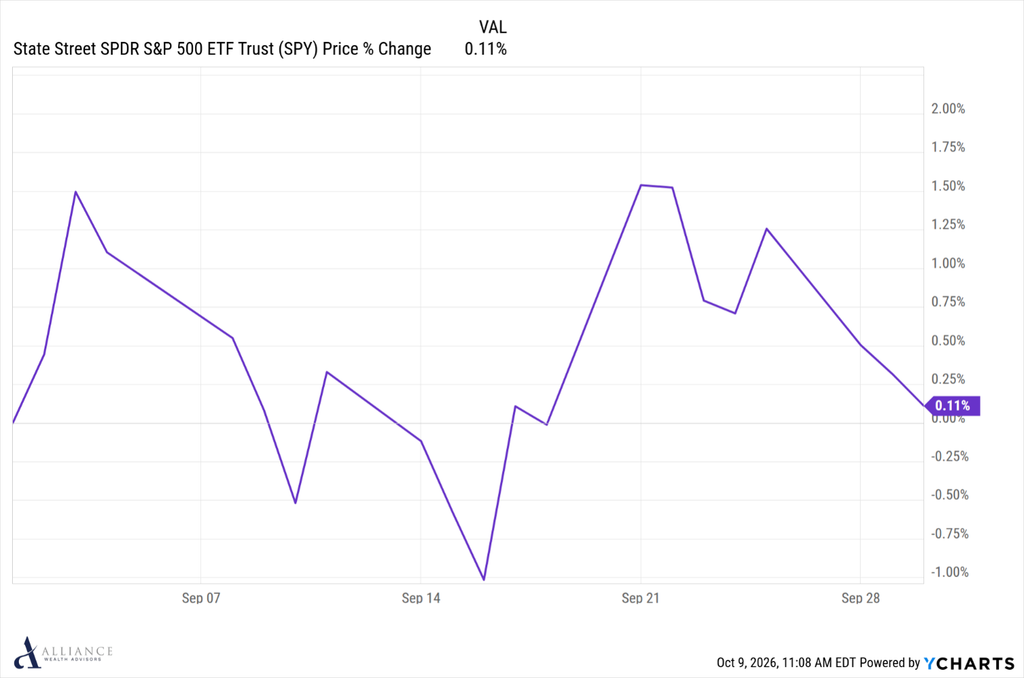
While market performance has been strong year to date with a return of 13.99%, September was a very flat month with a return of only .11%
Poor market performance in September is not unusual and statistically it is typically the worst month of the year for market performance:
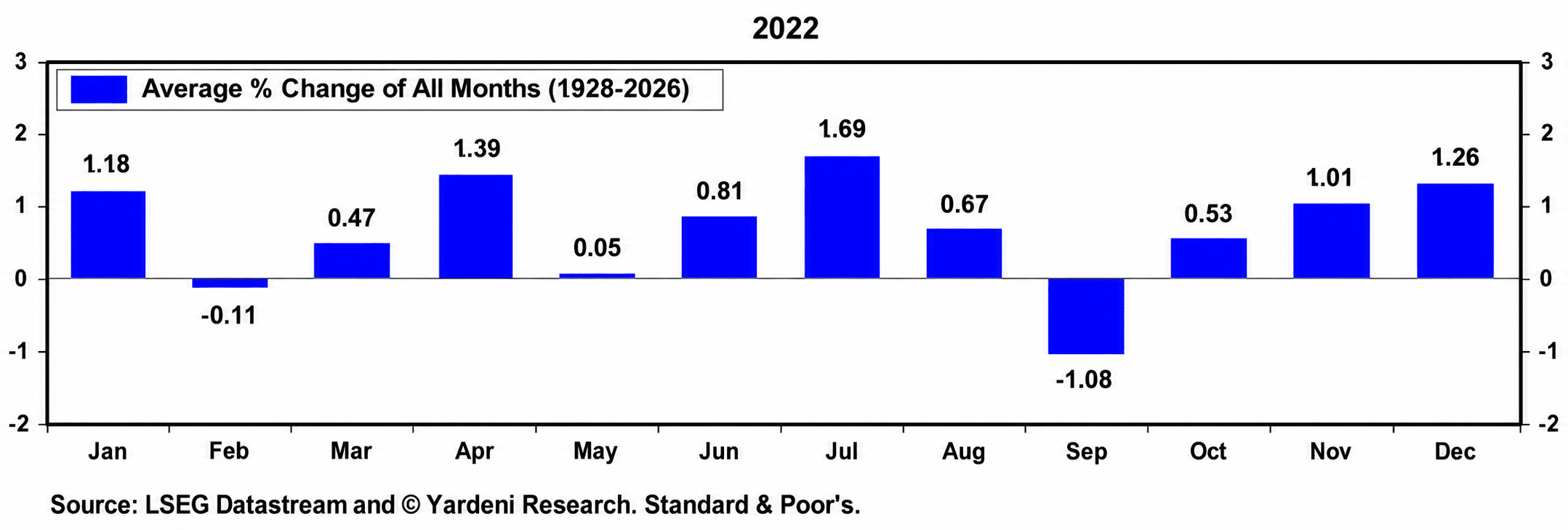
Why is September on average the worst month for market performance? One thought is that there is a material market re-engagement after summer. This thesis posits that summer volume is lighter and that the onset of fall leads to a broad re-evaluation of market drivers and a subsequent market repricing. Another thought is that fall is often shadowed by national elections every two years. These election cycles can lead to policy changes and perceptions around potential changes influences markets. In the fall, election outcomes start to crystalize far more than earlier in the year and markets respond accordingly.
At any rate, the silver lining is that early fall is followed by November and December which are typically some of the stronger performing months.
If some months are better than others, why not trade accordingly (i.e. sell every September 1 and buy every September 30). The answer is that there is tremendous year to year volatility and the statistics are driven by nearly 100 years of data. One would theoretically need to trade this over 100 years and have the outcome of the next 100 years be the same as the previous 100 years to get the same result.
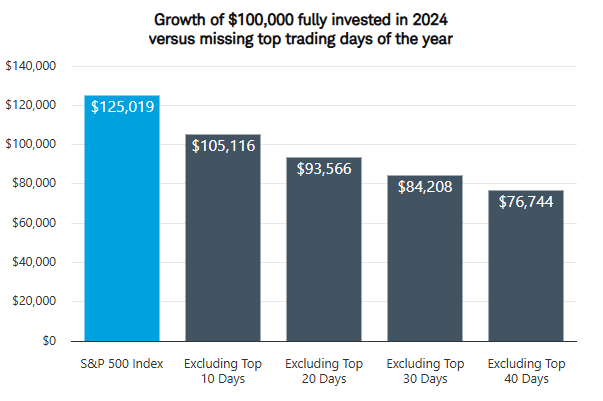
This underscores the fundamental investment principle that timing the market is difficult to impossible. Market timers get penalized significantly by the fact that a large chunk of market gains happen over a relatively small number of days. Because we can’t predict when these days will occur, being on the sidelines during these days harms performance significantly. Consider this case study from 2024:
Source: Charles Schwab
In this data set, if one invested $100,000 and stayed invested during the whole year, one would have ended the year with $125,019. If one happened to be out of the market for the top ten trading days, there would be nearly $20,000 less in investment returns. If one missed the top 40 days, one would not only have missed out on the gains but would have actually lost $23,356 of the initial investment.
It takes discipline and restraint to remain invested during periods of market volatility, but without these, we stack the odds against ourselves.
Current Outlook
This is a news and narrative rich environment and against the backdrop of everything going on, near-term volatility seems likely. Below are a few of the current themes driving markets along with some thoughts on each:
Inflation and interest rates. Interest rates have risen sharply over the past two months, and both the 10-year US Treasury and mortgage rates have surged:
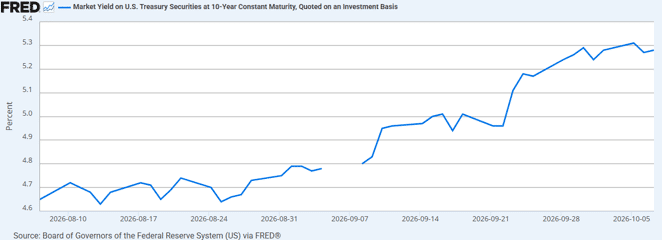
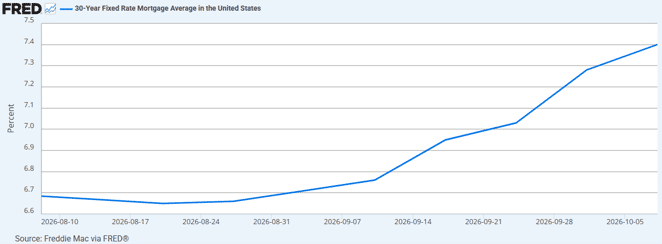
These rising rates represent a two-edged sword. On the one hand they raise borrowing costs and slow economic activity. On the other hand, they are a boon to savers and inject some much-needed fiscal realism into the economic discussion.
There is a goldilocks scenario where rates start reflecting economic reality, but don’t rise so much that economic activity is harmed. It seems likely that rates will either overshoot or undershoot and we’ll either see some economic drag or persistent inflationary pressure. The next few months will be telling as to whether rates start to settle out or if they continue to push upwards.
War and Energy Prices
The war in the Middle East remains a very fluid situation. The old adage, “the first casualty of war is the truth” is apropos here. It’s been difficult to ascertain what’s truly happening at times, but the following seems clear:
- Energy markets remain deeply disrupted
- The US blockade does appear to be working very effectively and is creating cracks and stress in the Iranian regime
- The midterm elections are playing a role in the calculus and strategy of both the US and Iran
The Iranians and their proxies recognize that energy supply disruption remains their most effective tool and are pursing this with impunity wherever they can. The US and its allies are attempting to provide both secure and alternative energy passage. It seems somewhat unlikely that we’ll have a durable peace ahead of the midterms and that we’ll potentially see an escalation from the US post-midterms.
Energy prices remain elevated (see the YTD price increase for diesel fuel) and are both an economic drag and a political liability for Republicans:

On that note, we continue to see President Trump’s approval rating decline (see below) and polymarkets are pointing toward Democrats flipping both the House and the Senate.
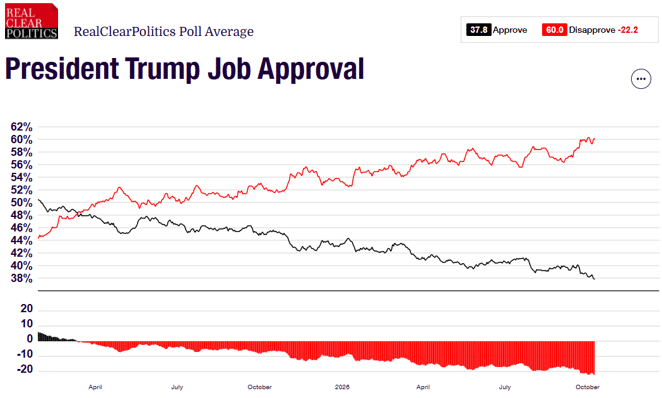
Markets have likely priced in both a Democratic sweep and gridlock politics for the next two years.
Conclusion
All of the above points towards a chaotic news cycle and potential volatility. At times like these it’s helpful to zoom out and keep in mind the big picture. Consider the following two charts. The first shows the stock market drawdown in the roughly one-month period when COVID initially hit:
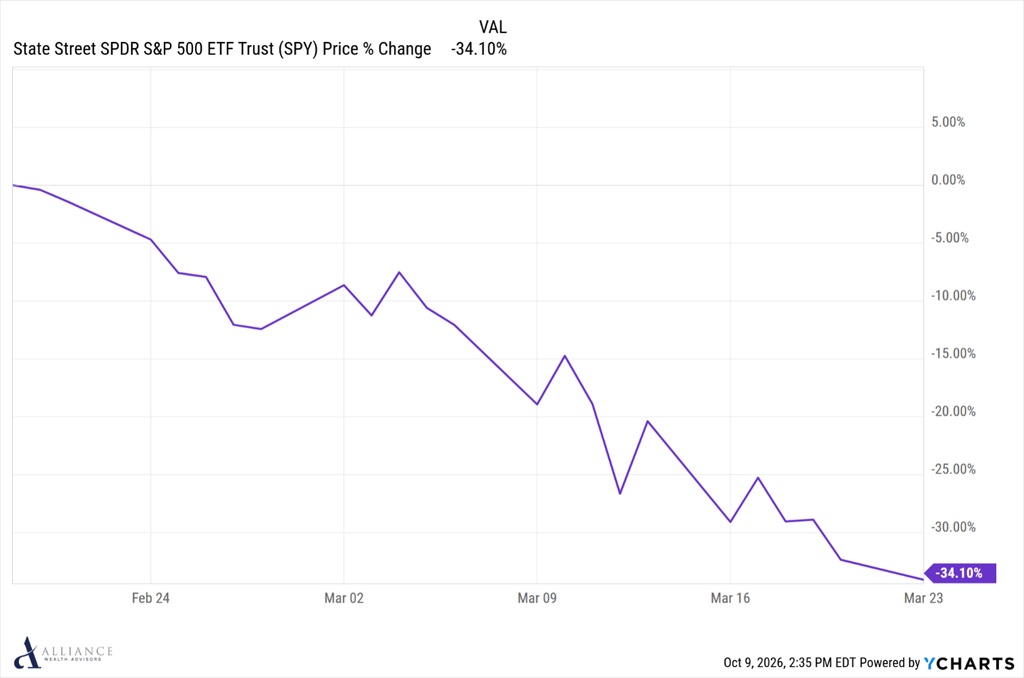
This is a scary chart in terms of market volatility and one that could drive investors into leaving markets altogether. The next chart, however, paints a different picture:
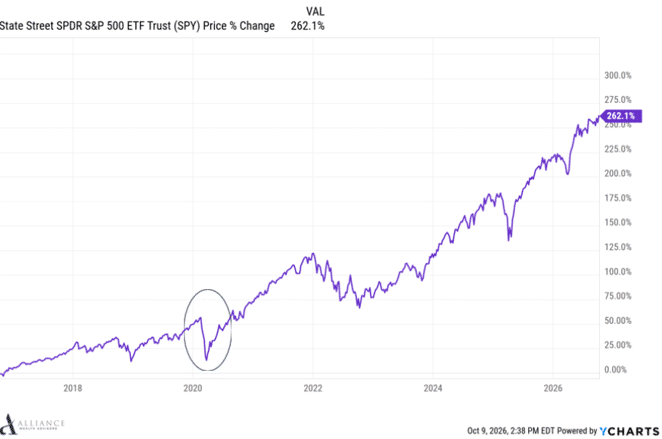
This chart shows the past 10 years of market performance, and the COVID drop (circled) is little more than a blip on the radar.
Perspective is incredibly important as an investor. We’ll encounter periods of market drawdown and volatility at some point in the future. It may be next month, next year or in two years, but it will happen. When it does happen, keeping a long-term perspective helps us ride out the rough patches.
To ensure we can communicate with you effectively, please notify Alliance Wealth right away if your address, phone number, or email address changes. Outdated contact information may result in missed or delayed communications.
The information provided here is for general informational purposes only and should not be considered an individualized recommendation or personalized investment advice. The investment strategies mentioned here may not be suitable for everyone. Each investor needs to review an investment strategy for his or her own particular situation before making any investment decision.
Diversification, asset allocation and rebalancing strategies do not ensure a profit and do not protect against losses in declining markets. Rebalancing may cause investors to incur transaction costs and, when rebalancing a non-retirement account, taxable events may be created that may affect your tax liability.
Investing involves risk, including loss of principal. Supporting documentation for any claims or statistical information is available upon request.
All expressions of opinion are subject to change without notice in reaction to shifting market conditions. Data contained herein from third-party providers is obtained from what are considered reliable sources. However, its accuracy, completeness or reliability cannot be guaranteed. Examples provided are for illustrative purposes only and not intended to be reflective of results you can expect to achieve. Past performance is no guarantee of future results and the opinions presented cannot be viewed as an indicator of future performance.
Alliance Wealth Advisors, LLC, is registered as an investment advisor with the SEC and only transacts business in states where it is properly registered, or is excluded or exempted from registration requirements. SEC registration does not constitute an endorsement of the firm by the Commission nor does it indicate that the advisor has attained a particular level of skill or ability a SEC Registered Investment Advisor – 1148 West Legacy Crossing Blvd., Suite 110, Centerville, UT 84014.